01 / Goal
Keep the car moving.
Clear the stages across all three days before you wreck the car.
Finish the final stage of Day 3.
The rally ends immediately when the fifth fault is taken.
02 / Components
What is in the deck.
03 / Setup
Set the start line.
- 1
Shuffle the Crew deck, Stage deck, and Fault pile separately.
- 2
Deal four Stage cards face up in a vertical list, from top to bottom. Keep every call visible.
- 3
Deal each player a starting hand. Leave room for a face-up Shared Reserve.
- 4
Choose a first player at random. Turns move clockwise.
| Players | Cards each |
|---|---|
| 2 | 8 |
| 3 | 7 |
| 4 | 6 |
04 / Stages & calls
Read top to bottom.
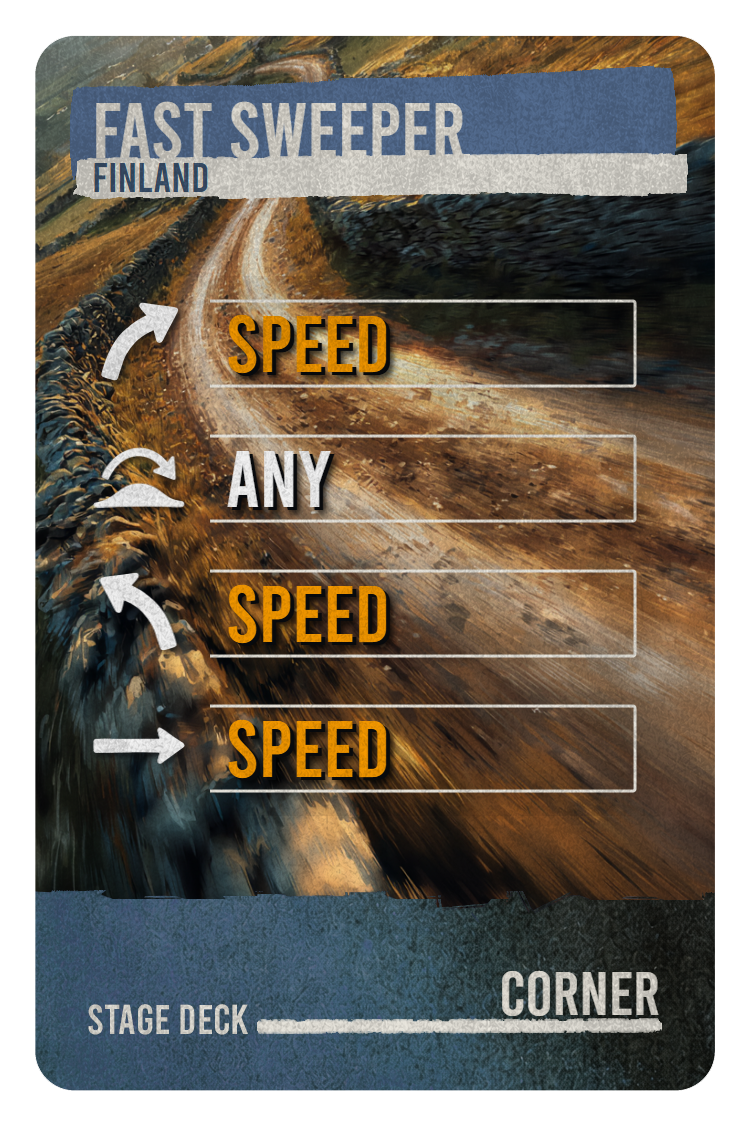
Stage cards are arranged top to bottom. Start with the top Stage and move down only after it is clear.
Calls on each Stage are also read top to bottom. The first unresolved call is live; its icon shows the corner and its colour names the stat needed to hit it.
Any accepts a Speed, Grip, or Control card. The remaining calls and later Stages stay visible so the crew can plan ahead.
Once every call has resolved as a Hit or Miss, clear that Stage and continue to the next one below it.
05 / Your turn
Play the live call.
- 1
Read the live call at the top of the current Stage.
- 2
Play one Crew card from your hand, or play a face-up card from the Shared Reserve.
- 3
A matching Speed, Grip, or Control card is a Hit. Resolve its effect, then follow any draw or extra play it gives you.
- 4
A non-matching typed card is a Miss. Ignore its effect, draw a Fault, and move on.
Example · Hit
The live call is Grip. You play a Grip card.
The call is a Hit. Add the card face up to the Hit stack, resolve its effect, and continue if it lets you play again.
Example · Miss
The live call is Grip. You play a Speed card.
The call is a Miss. Discard the played card and the Hit stack, do not resolve the card’s effect, and draw a Fault.
Cannot play
If you cannot play a card, draw a Fault.
Mark the live call as a Miss and move on. Do not draw a Crew card to replace it.
06 / Chains & draws
Build the run.
- Card effects resolve only after a Hit. A Miss does not draw or chain.
- “Play again” means immediately deal with the next live call before the turn passes.
- Play Again is always optional. You may stop and end your turn instead.
- The call decides the result: a matching card is always a Hit and a mismatching typed card is always a Miss. You do not choose between them.
- An effect that returns or gives the next played card follows that card whether it Hits or Misses. If no card is played, there is nothing to return or give.
- If a Speed, Grip, or Control card’s condition is not met, it may still Hit a matching call, but its effect does not resolve. A Skill can only be played when its condition is met.
- You may decline an effect that says “may.”
Example · Streak
Turn one Hit into two plays of the same stat.
If the crew already has a Streak of 1 or more, a Speed Streak that Hits the live call also Hits the next open call as Speed. The previous Hit can be any stat. The second Hit spends no card, even when that next call would not normally accept Speed.
07 / Faults
Faults add road.
When you Miss, draw the top Fault and place it face up with the Stages. Add that Fault’s Recovery Stage to the bottom of the current day.
A Recovery Stage is required road: the crew must clear it before the day can end. If the Fault remains on the car, add its Recovery Stage again at the bottom of every later day.
When an effect repairs a Fault, return it to the Fault pile and remove its untouched Recovery Stage if it is still ahead. The rally ends immediately when the fifth Fault is taken.
08 / End of day
Service, then go again.
After all four Stage cards and every Recovery Stage are clear:
- 1
Each player may discard any cards they do not want. If a player is over the hand limit, they must discard down to it.
- 2
Draw up to the normal hand limit: 8 cards with 2 players, 7 cards with 3 players, or 6 cards with 4 players.
- 3
Discard the Hit stack.
- 4
Deal four new Stage cards face up from top to bottom.
- 5
The starting-player marker moves one seat clockwise.
Cards in the Shared Reserve remain there between Stages and Days until someone uses them. There is no service after Day 3: clearing its final required Stage wins the rally.
09 / Keywords
Use the same language.
Draw N cards into your hand. If the Crew deck is empty, shuffle the discard pile and continue drawing.
Choose N cards from your hand and place them in the Crew discard pile.
You may play up to N additional calls before your turn ends. Play Again is always optional: you may stop before using every granted play. Without a number, Play Again means one additional play.
Change the affected upcoming call to Speed, Grip, Control, or Any. It never changes the call currently being filled.
The effect applies when the run already contains at least N consecutive Hits. The card must Hit, and its own Hit does not satisfy its requirement.
A Speed, Grip, or Control card can Hit the call. Cover can also fill it.
Resolve every open call on that Stage as a Hit. These Hits build the Streak normally.
Choose a teammate to take the complete next turn. Play then continues clockwise from that player.
10 / Card effects
Build the Hit stack.
Each Crew card that Hits goes face up into the Hit stack. The stack carries across Stage boundaries. Discard it after a Miss and at the end of each day.
A condition decides whether a card’s effect resolves. It never stops a matching Speed, Grip, or Control card from Hitting.
The effect resolves whenever the card Hits.
Before adding the played card, count the Hits represented by the cards already in the Hit stack. Most cards represent one Hit; a Stage-clearing Skill represents one Hit for every open call it cleared. If the total is at least X, the effect resolves. The played card’s own Hit does not satisfy its requirement.
Teach it in four sentences
- Read the Stages and their calls from top to bottom.
- Play a matching card to Hit; a mismatch is a Miss and draws a Fault.
- Effects happen only on Hits, and extra plays can build powerful conditions.
- Faults add required Recovery Stages; finish Day 3 before the fifth Fault wrecks the car.
11 / Optional challenges
How hard can it be?
Choose any number of these challenges before setup. Their effects combine.
Start the rally with 2 random Faults. Add their Recovery Stages as normal.
Deal 1 additional ordinary Stage card each day.
Deal each player 1 fewer card at the start of the rally. Between days, refill hands to 1 below the normal hand size.
Treat every printed Any call on Stage cards as Speed. Effects that change calls still work normally.
The first Miss of each day gives the player who missed 1 additional random Fault.
Whenever you Miss, discard 1 additional card from your hand, if able.
12 / Optional variant
Solo mode: take the wheel.
Run the rally on your own.
Play using the normal rules, with these changes:
- Start with 10 Crew cards. Use 10 as your normal hand size for card effects and service between days.
- Deal 3 ordinary Stage cards each day. Add and clear all required Recovery Stages as normal.
- Once per day, on your turn with 2 or fewer cards in hand, you may draw 3 cards. Finish resolving any pending card effect first. This does not spend a card play or count as a Skill. The ability refreshes at the start of each day; unused uses do not carry over.
- Ignore effects that require another player; resolve the remaining effects normally. For example, Handover still draws 2 cards, and Regroup draws 1.
- You take every turn. When your turn ends, begin a new turn and reset turn-based limits as normal.
Finish all required road across three days to win. The fifth Fault still ends the rally immediately.
13 / Optional variant
Versus mode: claim the road.
Race as one crew. Score as rivals.
Play using all the normal rules. When a player resolves the final open call on a Stage card, that player claims it and keeps it face up. If a card effect clears a Stage, the player who played that card claims it.
Recovery Stages cannot be claimed. When the rally ends—either after the final required Stage of Day 3 or when the fifth Fault is taken—count each player’s claimed Stage cards. The player with the most Stage cards wins. Tied players share the win.